I was attracted to IFS because it is the kindest, most unshaming therapy modality I have encountered. It opens space for authenticity and greater acceptance and courage because it supports us to notice the positive intentions behind patterns that appear unhelpful even when on the surface they seem only to make us suffer.
For my clients, many of whom have felt shamed for who they are, this opens up a safe space to look more honestly at themselves on every level. In a culture in which we are used to evaluating, optimising, polishing, expecting constant growth and fast results, this frame of mind can be balsam for the soul.
Before diving into the IFS therapeutic model, I want to say that I believe that any therapeutic modality can provide us with some orientation, but should never be taken rigidly. The map that a therapy model provides is not the territory. Your psyche is highly individual and could never be fully explained by anyone’s model. Your different parts, patterns, needs, emotions, your entire inner life is different from anyone else’s so the therapeutic model needs to be held lightly as an orientation for personal discovery. I ask that you see our dialogue about IFS as an invitation to get to know your own internal family system, its quirks and intricacies with some playful self discovery and lightness.
Enhancing Self Leadership
An important central aim of IFS therapy is to enhance our self leadership. This means that we are attempting to relate openly to our inner life of thoughts, feelings, impulses, etc., with the aim of learning not to be hijacked by them. Instead we wish to open up to them, facing them with curiosity so as to learn how to befriend these “rogue” parts. We are interested in these aspects of our inner lives as if we were a diplomat in a foreign country we don’t know very well.
Commonly, when people seek therapy, there is an element of frustration and impatience. Some behaviours or emotional patterns have seemed to be getting in the way of leading life well so it’s understandable that there are some voices or parts inside that have strong opinions about it and really wish for change, the sooner the better! In IFS therapy, we listen to this request for change as one perspective, and we are always open to more perspectives. We make the assumption that there are no bad parts. In IFS therapy we don’t take sides and define some parts of the personality as good and some as bad. Instead we are respectful of the positive intentions and balancing acts involved in the different energies that often pull us in different directions. When we look deeply into the psyche we can usually find some different energies that play out with one another like a tug-of-war. This discovery is a gift because when we can attend to the various different parts that have a stake in the therapy goals, we have much more influence and capacity to befriend any resistant, unwilling parts with hesitations about our official goals. This approach enables us to grow in our clarity and wisdom and notice whatever had been missing before in order to move with more harmony through our lives.
Key terms in IFS therapy
One key essential component in IFS therapy is the idea of self energy. There are some qualities of self energy which are often repeated in the literature, and they include:
curiosity, compassion, calmness, confidence, courage, connectedness, clarity, creativity, perseverance, patience, presence, perspective, playfulness, attunement, appreciation, acceptance, acknowledgement, tenderness, warmth, kindness, open-mindedness and open-heartedness.
There are many more words that could encapsulate self energy but it would also be possible just to summarise all the words together under the term “love”.
A central aim in IFS therapy is to be more and more capable of living our lives from loving self leadership rather than from our parts. When we are more driven from our self leadership, we are grounded in our centred wisdom and have an overview of our parts. We notice their activation and are respectful of them and are able to regulate the relationship with them so that the familiar tugs-of-war are less activated.
The word “parts” appears often in IFS therapy so I’d like to introduce you to what we mean by “parts”. I’d like to invite you to see the names given to these things as door openers and under no circumstances as limiting labels.
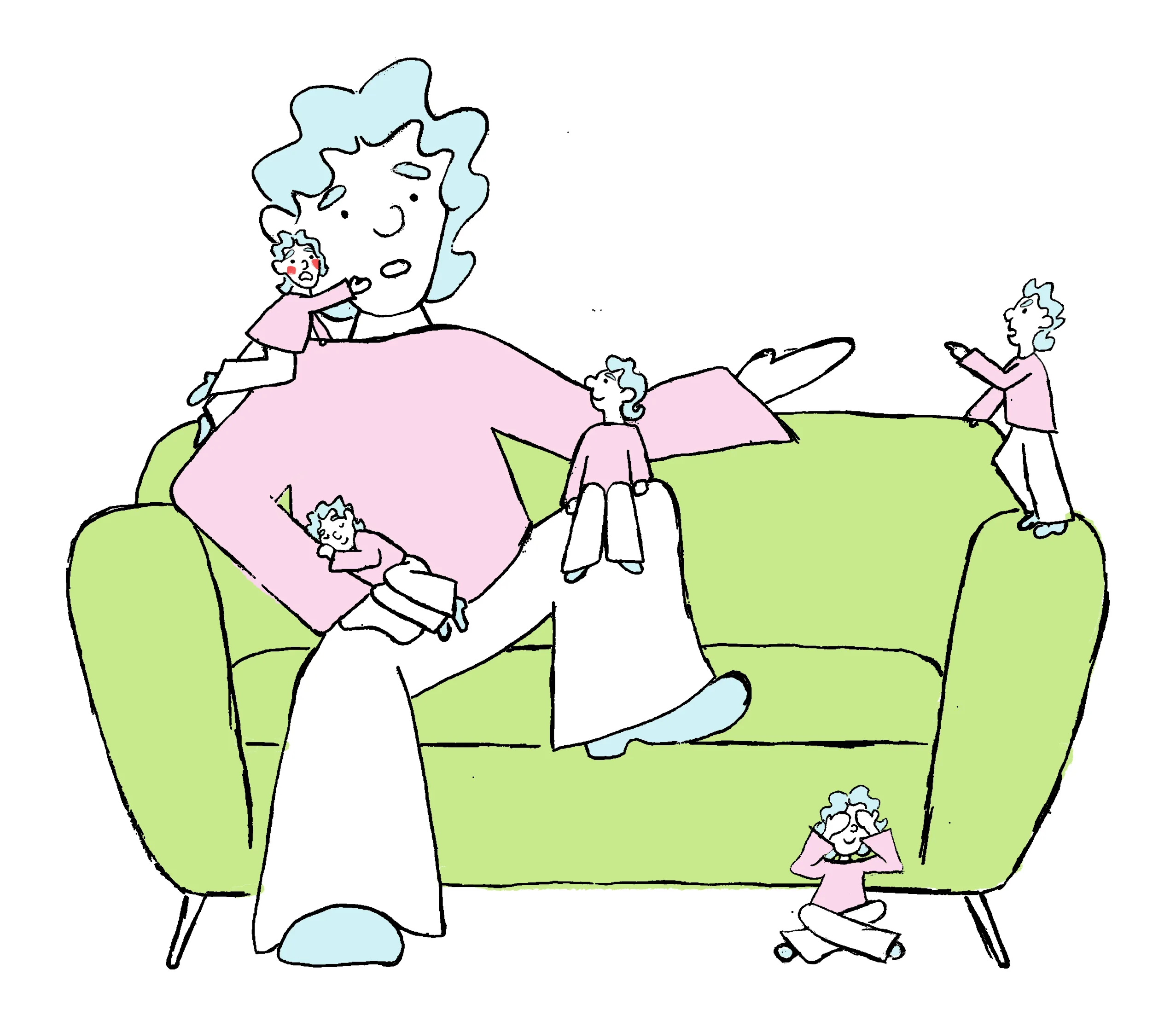
What types of parts are there? Parts are generally either protector parts, which can be pro-active or reactive and aim to try to protect us from pain, or they are exiles, parts that hold pain. With more self leadership available, we are more capable of reacting flexibly, exerting choice, responsive to what life and situations demand of us for our greater good.
The Pro-Active Parts
There are the parts that try to protect us from emotional pain through being pro-active, thinking in advance, guiding us, ordering us and our lives, typically these are known in IFS as “managers” but I think it can also be helpful to think of them as striving, organising, long-term thinking parts. Our pro-active protectors fulfil a lot of essential tasks: run our lives, do our banking, plan our vacations, make to-do lists, get us to work, like to appeal to the rational, and try to make us appear acceptable or even good for others to avoid shame. When these parts are at their most extreme, they may be harsh inner criticisers and shamers, with extremely high expectations, who can be involved in triggering guilt or shame when their standards are not adhered to.
The Reactive Parts
The next category of parts focus on soothing, providing comfort, protecting from distress, having fun, checking out, changing gears, and they provide balance to the striving, sometimes harsh or strict managerial parts. At times, when other resources are absent, these parts may lead us to alcohol and drug use, sexual risk-taking, rage, dissociation, watching porn, cutting, internet surfing, scrolling apps, using food or countless other habits. In IFS these parts are commonly known as “firefighters”, because in crises, they react to put out the flames of emotional fires with the powerful changes that distracting, extreme behaviors can provide to our brains and entire bodies. But they can also be thought of as soothers and distractors i.e. as parts that help us to let go and provide balance to the managerial side.
Both of these sets of parts aim to protect us from unpleasant or deeply distressing experiences. While the manager parts work proactively to try to keep these unpleasant experiences at bay, the firefighters spring into action when the deeply distressing experience has already been activated.
Capsules of Emotional Pain
Both of these types of protective parts are connected to capsules of unprocessed emotional pain, commonly known as “exiles”. We need to be able not to constantly feel the pain of past distress in order to function so this capsuling-off mechanism makes a lot of sense. As we go through life, there are many smaller and bigger ways in which painful, distressing experiences are stored away because they aren’t processed. For example, probably everyone experiences some rejections as they go through their childhoods, even if it is “just” some “lighter” situations such as being excluded from a group of children at school when we would like to play with them. Such experiences may not be processed well at the time and can lead to the formation of exiles, possibly influencing some aspects of our inner lives for many years to come.
At the other end of the spectrum, many of my clients experience much more dramatic and potentially painful situations where people on whom we are relying on to keep us safe in fact abuse or neglect us. These situations, though more serious than the minor rejections, may be experienced as so normal that they escape our attention for a very long time and only reveal themselves through careful self-observation of our automatic patterns in adult relationships.
One of many aims in IFS therapy is to allow these capsules of pain to receive the loving attention they need in order to free up some of their life energy. This process can make us feel lighter and reconnect us with qualities of self leadership that have been restricted by the energy required by the protector parts to save us from always feeling the pain.
To illustrate exiling I appreciate the comedian Wanda Sykes’ tragic but humorous example in her Netflix piece “I’m am entertainer!“ She describes being a young girl with a crush on her brother’s girlfriend’s sister and telling her “I wish I was a boy then I could be your girlfriend” which was then met with disgust and disapproval “That is disgusting. you don’t like girls! You like boys!”. The next step, where she places the experience in an imaginary drawer behind her, is the exiling “I guess I’ll put this in a box and deal with it when i can afford therapy”.
Burdens
Our parts carry burdens that may have been absorbed in various ways e.g. via personal experiences leading to exiling or as legacies from the environment that interacted with us as our personalities were forming or from the wider culture handed down from generation to generation. Cultural burdens are particularly relevant for many of my LGBTQIA+ clients. Cultural burdens are ideas transmitted to our psyche, often absorbed as truths early in life, which are not innately ours and may, in the long term, burden us more than they serve us even though they are so blended with our identity and how we think, feel and function in the world that it can seem preposterous to question them. This is very clear for cultural burdens around sexuality that present certain types of sexual expression as right and others as wrong. For many of my clients who were subjected to a classic male socialization, messages about the male role have usually been absorbed by the psyche, leading to a number of extreme burdens including such ideas as these:
- feeling and expressing any emotions except anger is wimpy and soft
- a man should always be in control and know all the the answers
- a real man should be ready for sex whenever an attractive woman presents herself
IFS therapy presents possibilities to unblend from these burdens by acknowledging them, being curious about them and enhancing self leadership. Through staying focused on the theme in a loving way, we can end up much less dominated by these burdens and we can often even find out what gifts are held within them that we can choose to use when it is conducive to our self leadership.
Who can benefit from IFS therapy with me?
If have tried hard already on your own to fight the problems you experience in your life and are open to a gentler, inquisitive but patient approach, IFS therapy may support you well. Together we slow down and really connect with what is going on inside you, becoming curious to discover the wisdom contained in the energy that appears to be standing in your way. We invite connection in self leadership in order to understand and bring the energy on board in a way that serves you as a whole person.
Do you know the story about the Sun and the North Wind arguing about which of them is stronger? It’s a lovely story to finish off this explanation of key IFS terms. To settle their question, the Sun and the North Wind agreed to put their power to the test. Each would try to make a traveler walking along the road take off his coat. The North Wind went first. He hurled himself at the traveler with all his might, tugging and pulling at the coat, wilder and more forcefully each moment. But the harder he blew, the more tightly the man wrapped himself in his coat. Eventually, the North Wind had to give up his furious efforts. The Sun had been watching with a gentle smile. Now it shone warmer and warmer, its light full of quiet confidence and warmth. Before long, the traveler loosened his coat — and soon he took it off entirely. The Sun had won. In IFS terms, the warm-hearted, beaming sunshine of gentle, loving kindness, with its patience and curiosity and all its self leadership, is ultimately the more powerful force, evoking cooperation and greater harmony.
My Invitation
If you think IFS therapy with me could support you with the next steps you are facing in your personal development, I’d love to hear from you.